Skip to content
cap-impactFrançais

Track record

What we did, and for whom

For each assignment: the client, the period, our exact role and what was delivered. The results belong to our clients; our role is to give them the methods, the proof and the room to achieve them.

Protecting people

UNDP climate safeguards: GEF and Green Climate Fund portfolio

Client
United Nations Development Programme (UNDP), climate team
Period
Until 2024
Our role
Marine Gauthier, Senior Technical Advisor on safeguards, heading a team of four
Scope
More than 150 projects funded by the Global Environment Facility (GEF) and the Green Climate Fund (GCF), in more than 50 countries
Deliverables
Social and environmental risk screenings, reviews of management frameworks, institutional guidance, on-site oversight missions
Read the detail

What Marine did. She led the application of UNDP’s social and environmental standards across the whole climate portfolio funded by the GEF and the GCF. She was the safeguards focal point for 22 Green Climate Fund projects, from design to reporting: she worked directly with the Fund, integrated its comments into the files and brought them into line with its requirements before approval. She drafted institutional guidance applied by other teams, and led oversight missions to check on site that the measures announced existed.
Green Climate Fund accreditation: environmental and social management systems of African development banks

Clients
African development banks, through UNDP
Period
2023 to 2024
Our role
Marine Gauthier, UNDP's GCF safeguards focal point
Deliverables
Support to upgrade their environmental and social management systems (ESMS) against the Green Climate Fund's accreditation requirements
Result
The banks were accredited by the Green Climate Fund

Environmental, social and human rights due diligence for a national park, Congo Basin

Client
An international conservation NGO, managing the park with the national protected areas authority
Our role
International consultant, with a national consultant in charge of village visits
Deliverables
Stakeholder mapping, analysis against four sets of standards, risk assessment, gap analysis, environmental and social action plan
Result
Due diligence that allowed the three funders of the new management agreement to decide with full knowledge
Read the detail

The context. A national park in Central Africa was moving to a new management contract, held by an international conservation NGO together with the national protected areas authority, and financed by a development bank, a bilateral agency and a dedicated fund. The site carried a documented and contested legacy: forced evictions, human rights violations in law enforcement, breaches of free, prior and informed consent, gender-based violence, boundary conflicts, specific impacts on Indigenous communities. No funder could finance what came next without serious due diligence, and no serious due diligence could be done without talking to the communities concerned.

What we did. Stakeholder mapping in three stages: identification, connectivity, values and priorities. Systematic analysis of the project against four sets of standards, applying the most demanding norm at every divergence. Risk assessment explicitly separating the inherited legacy from the risks attached to the new management arrangement. Gap analysis across law enforcement procedures, grievance mechanisms, consent protocols and the protection of women and children. Then a gap-closure environmental and social action plan, presented back to the local team in a workshop.

Two methodological choices. We limited the international consultant’s work to the provincial capital and gave all village visits to the national consultant: in a context of rising tension, the presence of a foreigner narrowed the space for speech rather than opening it. And the conclusions were returned to everyone consulted: by email for international actors, by telephone for civil society organizations, in person in the villages, with a second round of visits at the end of the assignment.

Working with local actors

Structuring a national network of four hundred organizations, DRC

Clients
Rainforest Foundation Norway, then UNDP
Period
2014 to 2016
Our role
Support to the restructuring of the renewed Climate REDD+ Working Group (GTCR-R)
Deliverables
Network governance and representation, information flows between Kinshasa and the provinces, a common position; a lessons-learned analysis for 2009-2015 published by UNDP and Rainforest Foundation Norway
Result
A 400-organization network anchored nationally and able to carry a common position in the REDD+ process
Read the detail

The context. The Congolese REDD+ process called for civil society participation without the conditions for it being in place: contested representation, no shared vision, poor information flow between Kinshasa and the provinces. Formal participation, in other words, with no real capacity to weigh.

What we did. The work covered the network’s governance, its representation, its information channels and its ability to carry a common position in the national process. It produced a published analysis of lessons learned over 2009-2015, co-edited by UNDP and Rainforest Foundation Norway.

“CAP!'s advisement of our network of 400 organizations has allowed us to be anchored at a national level, to develop a common vision and to benefit from an excellent communications system. We have become more effective, all together.”

Julien Kabalako, National Coordinator, GTCR-R

Understanding, and making it known

Strategic review and reorientation of a country program, DRC

Client
Forest Peoples Programme
Our role
Strategic evaluation: design, interviews at headquarters, in Kinshasa and in the field, analysis and recommendations
Deliverables
Political economy analysis, stakeholder mapping, recommendations on strategy, partnerships, structure and resources
Result
The reorientation shaped the concept note submitted to the funder the following year, then a five-year program
Read the detail

The context. An international NGO working on forest peoples’ rights was completing a three-year program funded by a bilateral agency and delivered by six partners across eight provinces. It had to decide what came next, with resources spread across too many sites and an open question: what role could it hold in this country?

What we did. A full documentary review. Interviews with the teams at headquarters and in Kinshasa, with the partners and three non-partner organizations. Community interviews in the field, in separate groups: women, young people, men, Indigenous peoples. Interviews with peers and with critics alike: bilateral funders, competing international NGOs, financial institutions, the national REDD+ coordination. Then political economy analysis, stakeholder mapping, and recommendations.

The result. A deliberate reorientation: work in fewer places and far more directly with communities, define the country mission as that of a human rights organization, narrow to three areas of focus, reduce funding to national networks in favor of grassroots organizations, and lower overall financial risk.

Other research and study assignments

  • CCFD-Terre Solidaire

    2026-2027 · ongoing

    Research on pesticides.

  • Fern

    Six countries in Central and West Africa

    Study on how NDCs contribute to forest governance, carried out with partner organizations and presented at national workshops before publication.

  • Rainforest Foundation Norway

    2012-2020 · DRC

    Participatory 3D modeling with the communities of the Itombwe Nature Reserve; green book published in French and English.

  • Rights and Resources Initiative

    2026 · ongoing

    Research on community experiences with carbon initiatives.

  • Rights and Resources Initiative

    2018 · DRC

    Analysis of the cumulative impacts and risks of REDD+ initiatives in Mai-Ndombe for Indigenous peoples and local communities. A 75-page report.

  • SPIA / CGIAR

    2026 · ongoing

    Qualitative study of the policy influence of the “Seeds Without Borders” program.

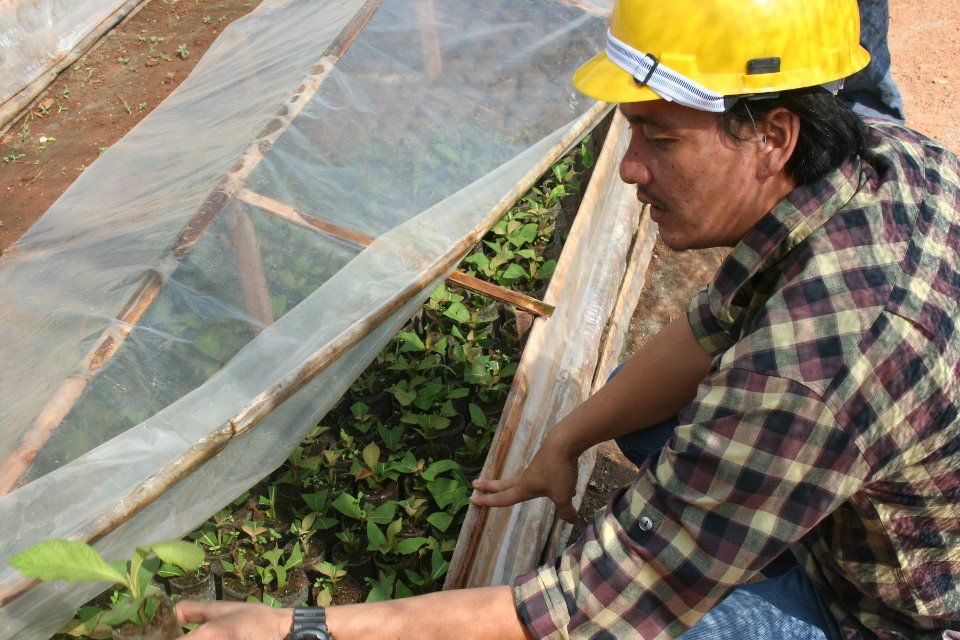
A man in a yellow hard hat lifts the plastic cover of a tree nursery full of young seedlings.
A reforestation nursery, Indonesia.

Since 2016

Before refocusing on climate and rights, the practice spent a decade equipping organizations to weigh on decisions. A few of the results our clients achieved over that period.

  • More than a million signatures gathered against glyphosate in six months.
  • Close to three hundred AFEV professionals trained in advocacy, negotiation and public speaking, across an eight-year partnership.
  • Four hundred Congolese civil society organizations brought into a single network around the REDD+ process, and a contribution to Côte d'Ivoire's national REDD+ strategy.
  • The European Patent Office confronted with citizens' voices on seed patenting.
  • Alternatives-Cameroun supported on decriminalization; transgender identity recognized in Vietnam.
  • Five HIV organizations supported across Africa; Alternatives-Côte d'Ivoire brought before the Universal Periodic Review.
  • Indigenous communities of South Kivu supported on their rights, with participatory consultation tools.
  • Two million dollars mobilized over three years in development aid.

“The trainer was professional and dynamic, and adapted herself perfectly to our requests, as well as to the needs, and political and cultural contexts, of each partner. Based on numerous examples and tools, the training was adapted to all experience levels and made concepts frequently considered abstract clear and practical.”

Anaïs Saint-Gal, Advocacy Officer, Sidaction

“It's always a pleasure to work with CAP! The collective is very efficient and determined to meet established expectations. Above all, they have an excellent working relationship with our local partners, who also appreciate them very much.”

Kevin Sasia, Program Coordinator, Central Africa Department, Rainforest Foundation Norway

“Working with CAP! is a pleasure. The consultant clearly defines the scope of work with attention and effectively delivers. She is always responsive and communicates clearly. We have been very happy with the quality of the work that has been done.”

Mika Leandro, Campaigns Director, WeMove Europe

Preparing a program, an accreditation or an evaluation?

Write us a few lines about what you are preparing and by when. We reply within two working days.